Chimney guides
After a Hail Claim, Check the Chimney Flashing
Texas replaces more roofs after hail than almost anywhere, and the chimney is a small part of a big job done at speed.
Short answer
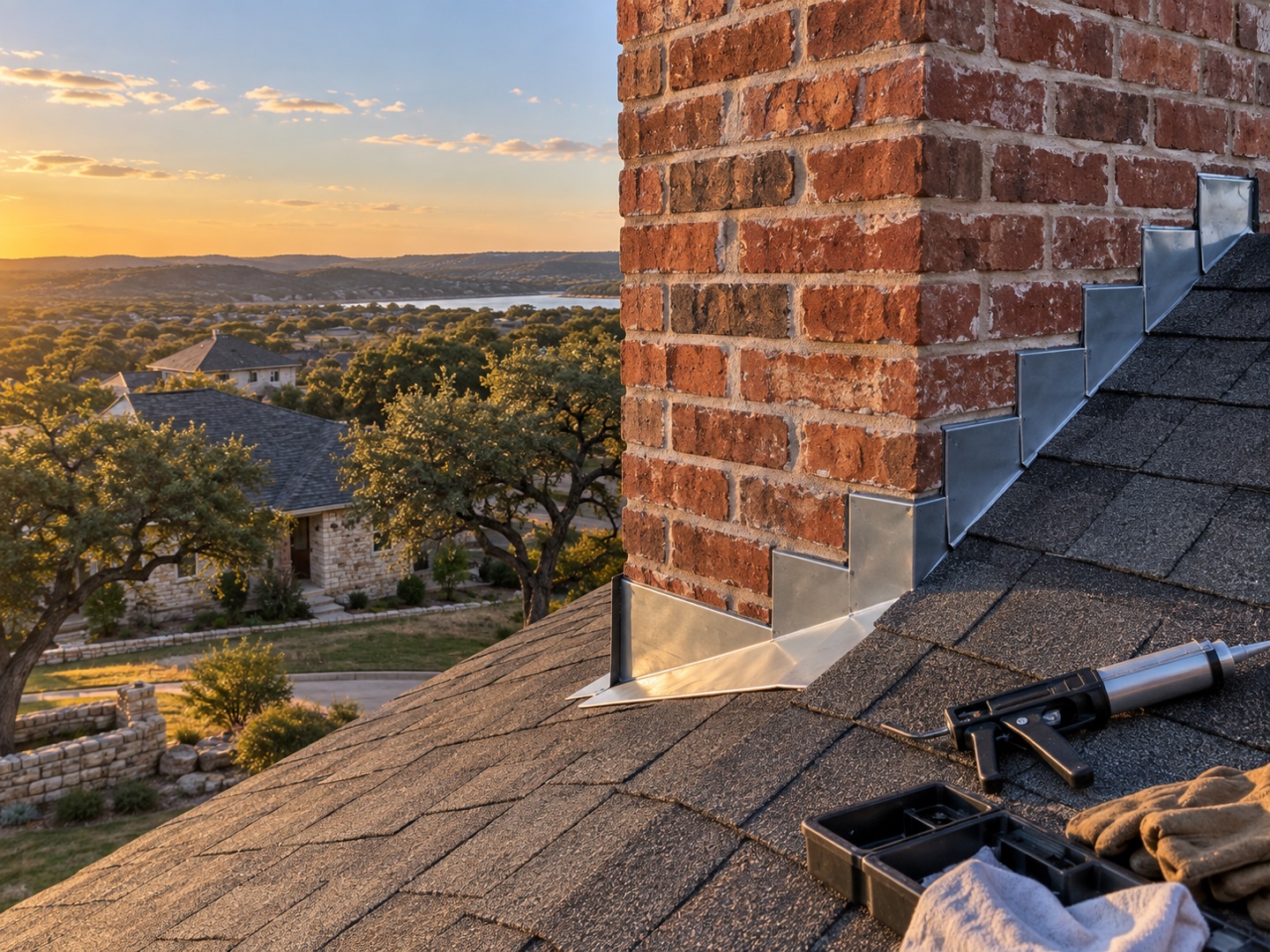
Chimney flashing is the detail most often rushed in a mass post-hail replacement. Correct flashing is two layers — step flashing woven in with the roof courses, and counter-flashing let into a groove cut in the mortar. Roof cement troweled across the joint is faster, common, and fails within a season or two. In Texas it fails sooner still, because soil movement is reopening the joint underneath it.
What correct looks like
You can judge a good deal of this from the ground with a photograph or binoculars.
Step flashing, not a continuous strip
Individual L-shaped pieces, one per shingle course, stepping up the side of the chimney. A single long piece of metal up the side is wrong on any pitched roof.
Counter-flashing cut into the mortar
A groove — a reglet — cut into a mortar joint, the metal turned into it and the joint pointed. Metal stuck to the face of the masonry with sealant fails when the sealant does.
No black mastic doing the waterproofing
A little sealant at terminations is normal. A trowel of roof cement across the whole joint is a patch, and it is what a rushed crew leaves behind.
Why it fails faster in Texas
Two reasons on top of the usual ones.
The first is heat. Texas sun takes surface sealant apart quickly — far faster than in a northern climate. A detail that relies on mastic has a genuinely short life here.
The second is movement. On expansive clay the chimney and the house are moving apart and back together seasonally. A flashing detail pinned tight, or sealed rigid, has no slack to accommodate that. It reopens, gets sealed again, and reopens. That is the cycle a lot of Texas homeowners are in without knowing why.
Detailing for movement
Counter-flashing with enough lap over the step flashing to tolerate seasonal movement, rather than metal fixed tight and caulked. Ask specifically about it if you have had a recurring gap.
What to do now if your roof was replaced on a claim
Three things, in order, and none of them costs much.
Photograph the flashing
From the ground, zoomed in. If what you see is a black smear where the chimney meets the roof rather than stepped metal, that is your answer.
Check the attic after the next heavy rain
Look at the framing and sheathing immediately around the chimney penetration for staining or damp. A leak that has not yet reached a ceiling is still a leak.
Raise it with the roofer while the warranty is live
Most roofing work carries a workmanship warranty. Flashing done badly during the replacement is a warranty item, not a new job, and it is a much easier conversation inside the warranty period than after it.
Need this done?
Chimney Flashing Repair across Texas
Free to use, no obligation — we never charge you.
Frequently asked questions
How do I know it is the flashing and not the crown?
Timing. Flashing leaks appear with wind-driven rain and often stop in ordinary showers. A cracked crown leaks whenever it rains. A hose test working upward in sections settles it.
Should the roofer or a chimney company do it?
Either, provided they cut a reglet and let the counter-flashing into the mortar. That is the question to ask rather than which trade they call themselves.
There is a stain but no drip. Does it matter?
Yes. Staining means water has been arriving and the framing behind has been wet. A stain that stopped growing usually means the water found another route.
Chimney services near you
- Houston
- San Antonio
- Dallas
- Austin
- Fort Worth
- El Paso
- Arlington
- Corpus Christi
- Plano
- Lubbock
- Irving
- Amarillo
- Garland
- Laredo
- Frisco
- McKinney
- Grand Prairie
- Killeen
- Brownsville
- Waco