Chimney guides
Why Your Chimney Is Pulling Away From the House
This is the most common chimney complaint in Texas and the one most often treated as a chimney problem when it is a ground problem.
Short answer
Much of Texas sits on expansive clay that swells when wet and shrinks in drought. The house moves with it and a masonry chimney — heavy, rigid, frequently on its own footing — moves on a different schedule. The gap that opens between them is a symptom. Filling it works until the next wet- dry cycle, which is why homeowners find themselves paying for the same repair repeatedly.
What the clay is doing
Expansive clay soils change volume with moisture content. Wet, they swell and lift. Dry, they shrink and settle. Across a North Texas year that cycle can move a slab measurably, and it does not move every part of it equally.
A chimney is the worst case for differential movement. It is far heavier per square foot than the wall beside it, it is rigid where the frame is not, and on a lot of Texas housing it sits on a separate footing from the main slab. So it responds to the soil on its own timetable while the house responds on another.
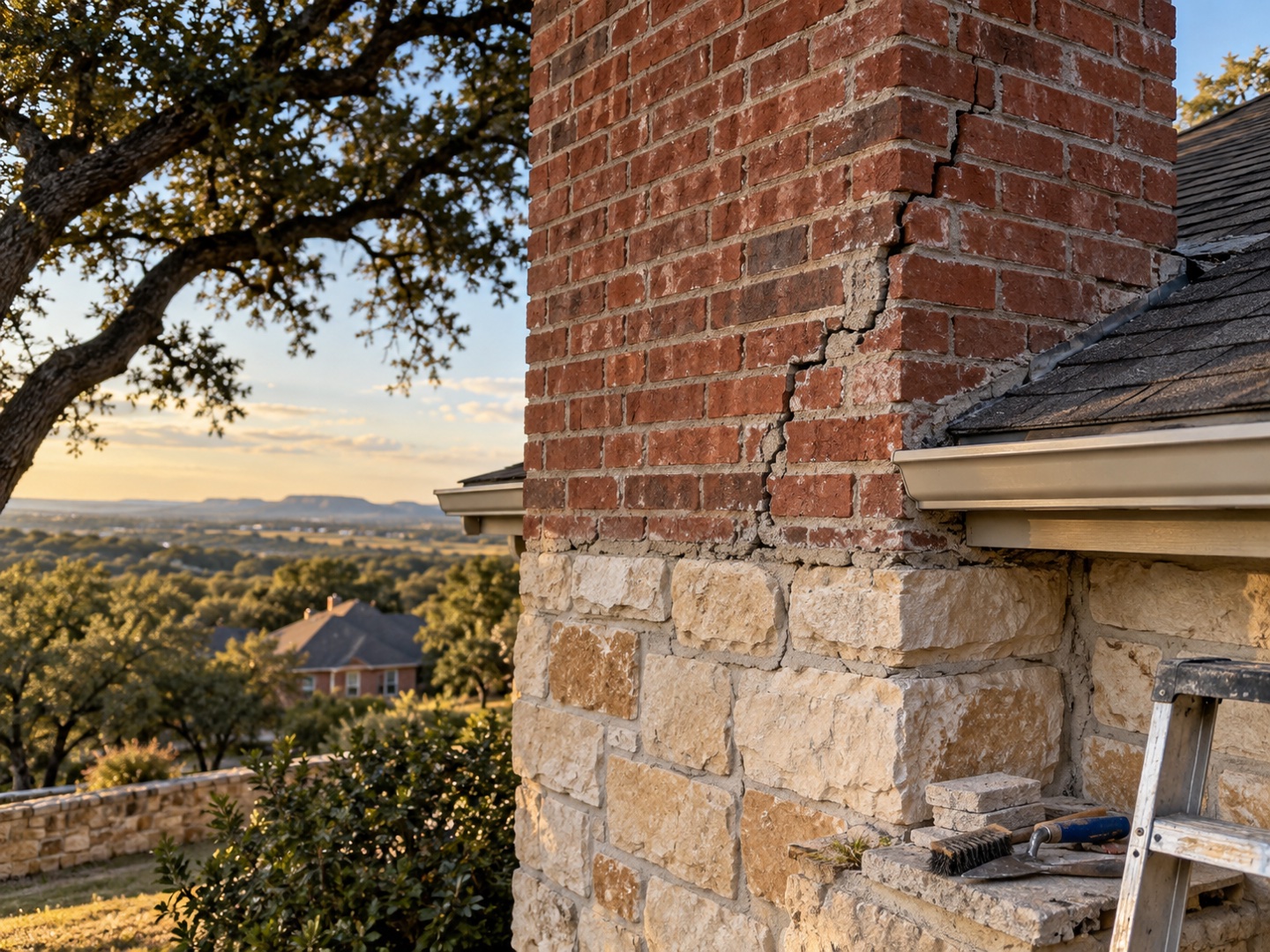
The result is one of three things: a chimney leaning away from the wall, a stepped diagonal crack running through the mortar joints, or a flashing gap that reopens every year no matter how often it is sealed.
Movement cracking versus weather cracking
Weather damage is surface scaling and spalled faces spread across an elevation. Movement is a single crack tracking diagonally through the joints, or a clean separation at the wall. Texas sees far less of the first than northern states and far more of the second.
What to do about it, in order
The sequence matters, because getting it backwards is how people pay twice.
First, establish whether it is still moving
That is the question everything else depends on. Movement that stabilized years ago can simply be repaired. Movement that is ongoing will reopen any repair. Monitoring over a season, or a foundation assessment, is what answers it.
Involve a foundation engineer if the signs are broader
If the house shows movement elsewhere — sticking doors, cracks over openings, uneven floors — the chimney is one symptom of a building- wide issue and a masonry contractor is the wrong first call.
Seal it as weather protection, not as the repair
A gap at the flashing lets water in, and water in the wall is its own problem. Sealing it while the movement question is settled is reasonable. Sealing it and calling the job done is not.
Then repair the masonry
Repointing or rebuilding once the ground has been addressed, with a flashing detail that has enough lap to accommodate future movement rather than being pinned tight.
Watering the foundation is not folklore
It sounds odd to anyone from outside Texas and it is widely recommended by foundation engineers here.
Keeping soil moisture around a slab more even through drought reduces the size of the seasonal swing, which reduces the differential movement. A soaker hose run on a schedule during dry spells is cheaper than any repair and it is prevention rather than cure — it will not reverse movement that has already happened.
The corollary matters too: drainage. Gutters that discharge beside the chimney, or a downspout dumping at its base, create exactly the local wet- dry extremes that move it.
Need this done?
Chimney Masonry Repair across Texas
Free to use, no obligation — we never charge you.
Frequently asked questions
Is a leaning chimney dangerous?
It depends how far and whether it is still moving. A slight separation that has been stable for a decade is a maintenance item. A stack that has visibly rotated or is out of plumb is a structural one and needs assessing rather than repointing.
Why does the gap keep coming back after sealing?
Because the soil is still moving the chimney and the house at different rates. That is a movement question, not a sealant question.
Will repointing fix it?
It will fix the mortar. It will not stop the movement, and on an actively moving stack the new mortar cracks in the same places.
Chimney services near you
- Houston
- San Antonio
- Dallas
- Austin
- Fort Worth
- El Paso
- Arlington
- Corpus Christi
- Plano
- Lubbock
- Irving
- Amarillo
- Garland
- Laredo
- Frisco
- McKinney
- Grand Prairie
- Killeen
- Brownsville
- Waco