Chimney guides
Buying in Texas? What the Chimney Inspection Should Answer
The chimney questions that matter in Texas are not the ones that matter in New England, and a generic inspection checklist misses most of them.
Short answer
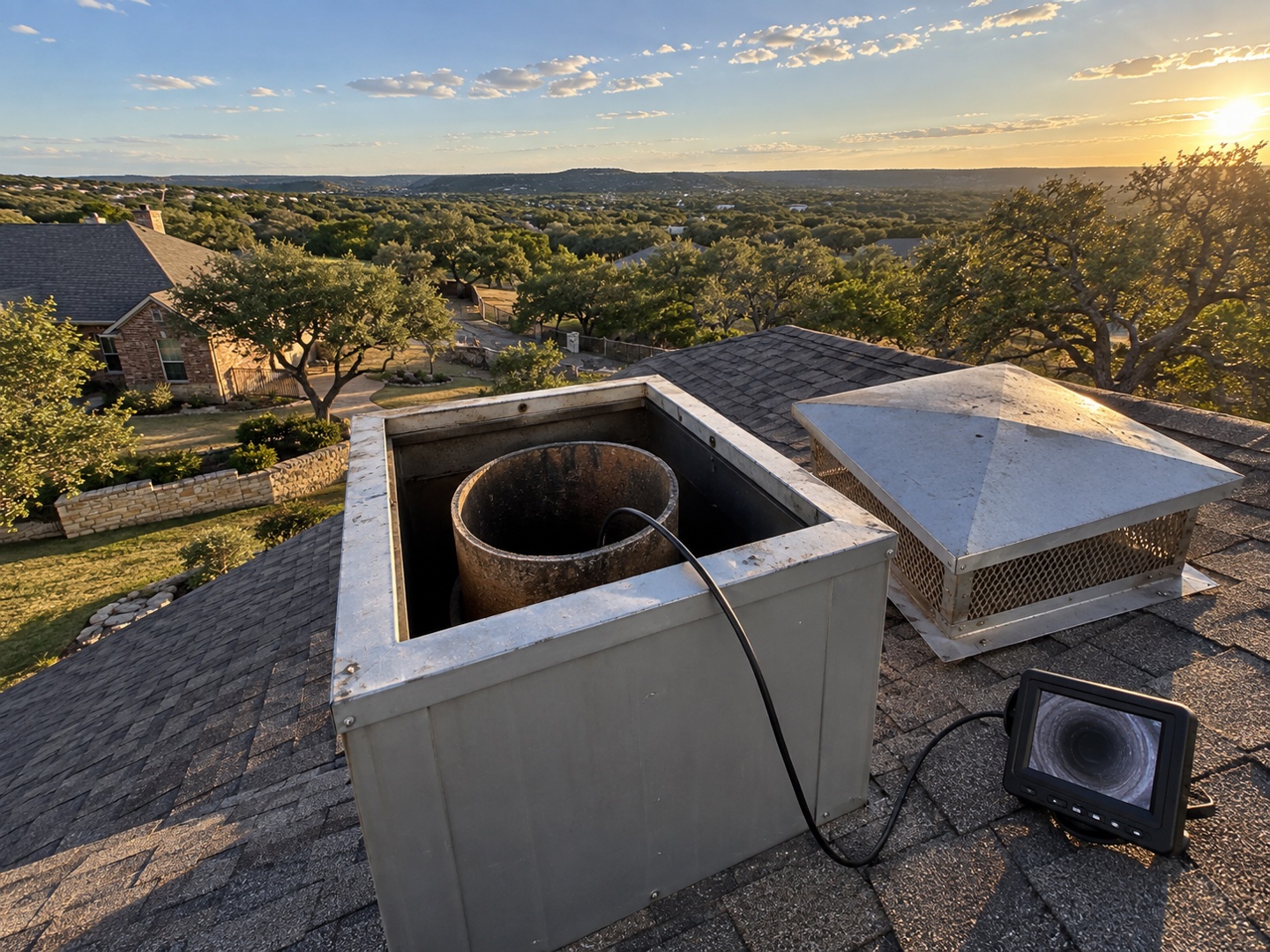
Three things a Texas chimney inspection should establish: whether the structure is masonry or a framed chase with a metal flue, whether any cracking is soil movement or weather, and whether a factory-built firebox still has parts available. A Level 2 inspection with a camera survey is the standard on a property transfer, and a general home inspector does none of the above.
The three Texas questions
Get these answered and you know what you are buying. Miss them and the surprises are expensive.
Masonry or chase?
It changes every subsequent answer. A masonry chimney has crowns, flue tiles, mortar joints and repointing. A framed chase has a chase cover, a metal flue system and a manufactured firebox. Most post-1980 Texas housing is the second, and treating it as the first is how inspections go wrong in both directions.
Movement or weather?
A stepped diagonal crack following the mortar joints, or a gap where the chimney meets the wall, is the soil. Surface scaling spread across a face is weather, and Texas sees far less of that. The distinction decides whether you are looking at a repointing job or a foundation conversation.
Are the firebox parts still made?
On a factory-built unit this is the question with the biggest cost swing. Panels available: a modest repair. Model discontinued: a new insert or a new appliance. The model number is on a metal label inside the firebox and it takes a minute to read.
What else comes back on Texas housing
Four common findings, and none of them is dramatic on its own.
A rusted chase cover
Close to universal on builder-fitted covers over about fifteen years old. Cheap to fix and worth raising, because water has been entering the chase.
Flashing bedded in mastic
Very common after a hail roof replacement. It will leak, and inside a roofer's workmanship warranty it is a much easier conversation.
A gas log set never serviced
Near-universal. Not a deal point, but worth knowing it needs a service visit rather than assuming it works.
A damper clamped open and forgotten
Correct for a vented gas set, and a permanent opening in a house you are about to start cooling. Worth understanding rather than fixing.
Timing and the report
During the option period, not after. A Level 2 takes an hour or two.
Ask for the report written, with photographs, separating safety defects from wear worth monitoring. On a Texas house also ask explicitly for a statement on whether cracking is structural — that is the finding that either is or is not a negotiating point, and a report that is vague about it is not much use.
Photograph it yourself first
From the ground, all reachable sides, before you book anything. A gap at the wall or a stepped crack is often visible once you know what you are looking for, and it tells the surveyor where to start.
Need this done?
Chimney Inspection across Texas
Free to use, no obligation — we never charge you.
Frequently asked questions
Will the general inspector cover the chimney?
Externally and superficially. No camera survey, no assessment of movement versus weather, and usually no identification of the firebox model.
Is it worth it if the fireplace is gas and decorative?
Yes. Gas sets need service, the chase cover corrodes regardless, and the damper arrangement is worth understanding before you own it.
Who pays for it?
Usually the buyer, as part of due diligence. It is a small fraction of what a missed structural finding costs.
Chimney services near you
- Houston
- San Antonio
- Dallas
- Austin
- Fort Worth
- El Paso
- Arlington
- Corpus Christi
- Plano
- Lubbock
- Irving
- Amarillo
- Garland
- Laredo
- Frisco
- McKinney
- Grand Prairie
- Killeen
- Brownsville
- Waco