Chimney guides
How Often Does a Texas Chimney Need Attention?
In a state where most fireplaces are gas and most gas fireplaces have never been serviced, the question people ask and the question they need answered are different.
Short answer
An annual inspection is the standard whatever the chimney serves — that is NFPA 211 and it covers gas appliances. Sweeping frequency depends on what you burn: annually where wood is genuinely used, which in Texas mostly means East Texas and the Hill Country. Across the metros the visit is an inspection plus a gas service, and the brush is close to incidental.
Three appliances, three reasons to book
What you have decides what the visit is for.
Wood
Creosote, and it is flammable. Annual minimum, mid-season check where a stove runs as primary heat. Mostly East Texas, the Piney Woods and the Hill Country.
Gas log set
Annual service — burner, pilot, thermocouple, gas pressure on a manometer, venting. Almost no residue to brush. This is the most commonly skipped service in Texas housing and the one where the faults are most likely to matter.
Factory-built firebox, any fuel
Annual inspection of the refractory panels, the chase cover from the roof, and the cap. On post-1980 Texas housing that is where the faults are, rather than in the flue.
What the visit finds that you would not
On a lightly used fireplace the sweeping is almost beside the point. What earns the money is what gets seen while someone is on the roof and in the firebox.
The chase cover
You cannot see it from the ground. It is the most common Texas chimney repair and this is the only routine occasion anyone looks at it.
Movement at the wall or roofline
A gap or a stepped crack that has opened since last year. Catching that early is the difference between repointing and a foundation conversation.
A seized or wrongly set damper
Common on anything unused, and on gas sets the clamp needs to still be there.
Nesting and debris
A warm open flue in a warm climate is attractive year round, and the tree canopy in East Texas drops into it constantly.
When to book it
Spring through early fall, which in Texas means most of the year is available. Availability is better outside the first cold snap, and if the visit finds masonry work, mortar needs settled weather above about 40°F to cure — easy here, but not in January in Amarillo.
The other argument for booking early is the Panhandle and West Texas, where there is a genuine winter. Those are the parts of the state where a no-heat chimney problem is actually urgent, and the parts where everyone calls in the same week.
Need this done?
Chimney Sweeping across Texas
Free to use, no obligation — we never charge you.
Frequently asked questions
Do gas fireplaces really need annual service?
Yes. Burner ports block, pilot assemblies collect dust and spiders, thermocouples fail, and the venting needs checking like any appliance. None of it is visible until it misbehaves.
Will sweeping make a mess in the house?
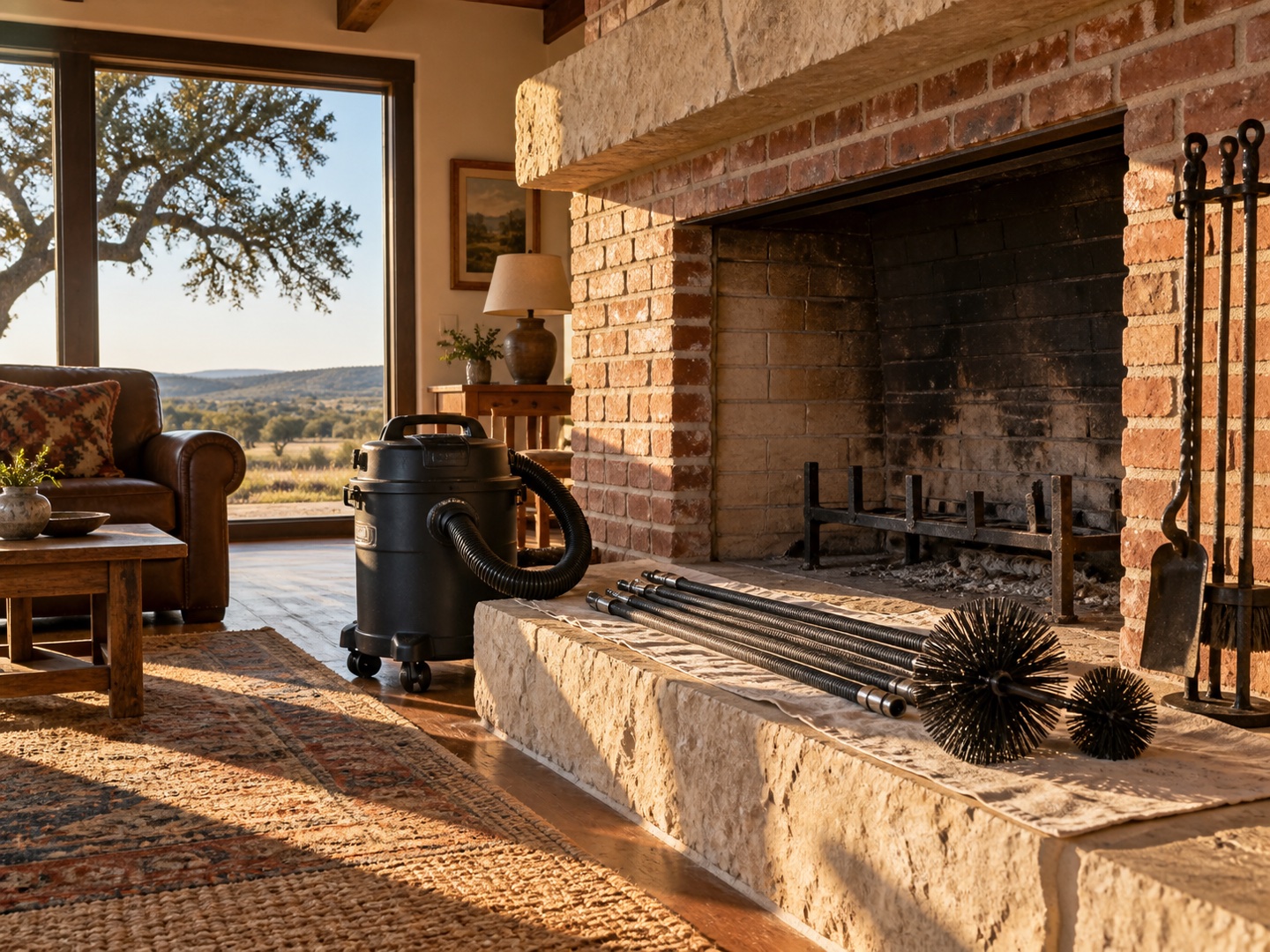
It should not. A sealed vacuum at the firebox holds everything and drop cloths cover the surroundings.
There is a smell from the fireplace in summer. Why?
Damp deposits plus humid air being drawn down the flue rather than up. Sweeping removes the source. A top-sealing damper addresses the airflow — unless a vented gas set requires the damper clamped open, which in Texas it usually does.
Chimney services near you
- Houston
- San Antonio
- Dallas
- Austin
- Fort Worth
- El Paso
- Arlington
- Corpus Christi
- Plano
- Lubbock
- Irving
- Amarillo
- Garland
- Laredo
- Frisco
- McKinney
- Grand Prairie
- Killeen
- Brownsville
- Waco